The drive along the Milford Road (State Highway 94) is one of those journeys where you spend as much time pulled over on the side of the road as you do actually driving. I know because I did exactly that – and I was only doing the return leg after a morning cruise.
On the way up we kept moving – we had a cruise departure to make and did not want to risk being late. The drive back was when I actually got to look at the road properly. So I stopped. A lot.
If you are doing a day trip to Milford Sound from Te Anau, build proper time into the drive itself. The 120km of SH94 through Fiordland National Park is not a road to bolt along. Allow at least three to four hours each way if you want to actually stop and look at things – which you should, because the road is as good as the destination.
What the Milford Road is
State Highway 94 runs from Te Anau to Milford Sound, cutting through Fiordland National Park. It is the only road in. The route passes through beech forest, glacier-carved valleys, alpine meadows and the Homer Tunnel before dropping into the Cleddau Valley near the sound.
There are no petrol stations or shops between Te Anau and Milford Sound. Fill up in Te Anau before you leave and bring food and water. Toilets are available at Te Anau, Knob’s Flat (about 80km from Te Anau) and at Milford Sound itself. Nowhere in between, so plan around that.
Without stops the drive takes about two hours. Most people doing a self-drive day trip allow four to five hours for the return journey including pullouts.
The Cleddau River
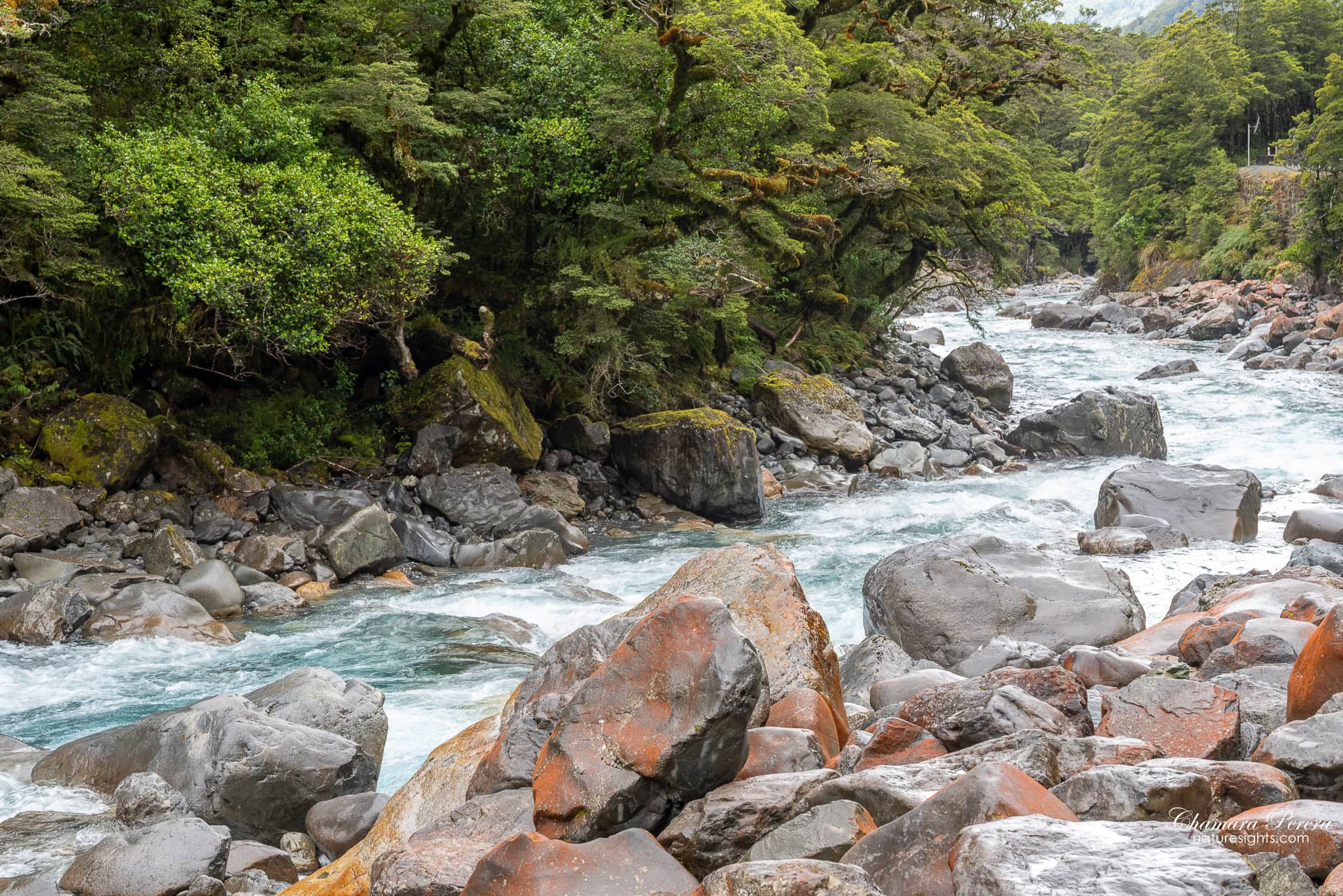
Coming back from Milford Sound, the Cleddau River is one of the first places worth stopping. I pulled over at a roadside parking area not long after leaving the wharf, drawn down to the riverbank by the colour of the water.
The Cleddau runs a deep turquoise – that glacial colour you get in rivers fed by snowmelt. Large boulders, many of them stained orange-red, line the banks. Native beech forest closes in tight on both sides and the river moves fast, funnelling between rocks before spreading around wider sections.
I scrambled down to the boulders and spent about 20 minutes photographing the water. The colour is extraordinary when you get close to it. The trees lean over the banks and there is a real sense of the rainforest pressing in from every direction.
The valley itself is worth watching as you drive through it. The walls are steep and furred with moss and fern, and on wet days the water runs off every rock face in thin white threads.

A mountain waterfall stop – unmarked
A few kilometres into the Cleddau Valley, I stopped at a widened road shoulder where the full scale of the mountains above came into view. The cloud was sitting at maybe the halfway point of the rock faces, and below it, multiple thin waterfalls were running straight down the cliff. The native beech in the foreground was bright green against the grey stone.
This is not on any tourist map. It was one of my favourite shots of the whole day.
On rainy days, these mountains come alive with temporary waterfalls that disappear within hours of the rain stopping. Drive the Milford Road in clear weather and you will likely miss them. There are cases where bad weather is the better choice.

Eglinton Valley lupins
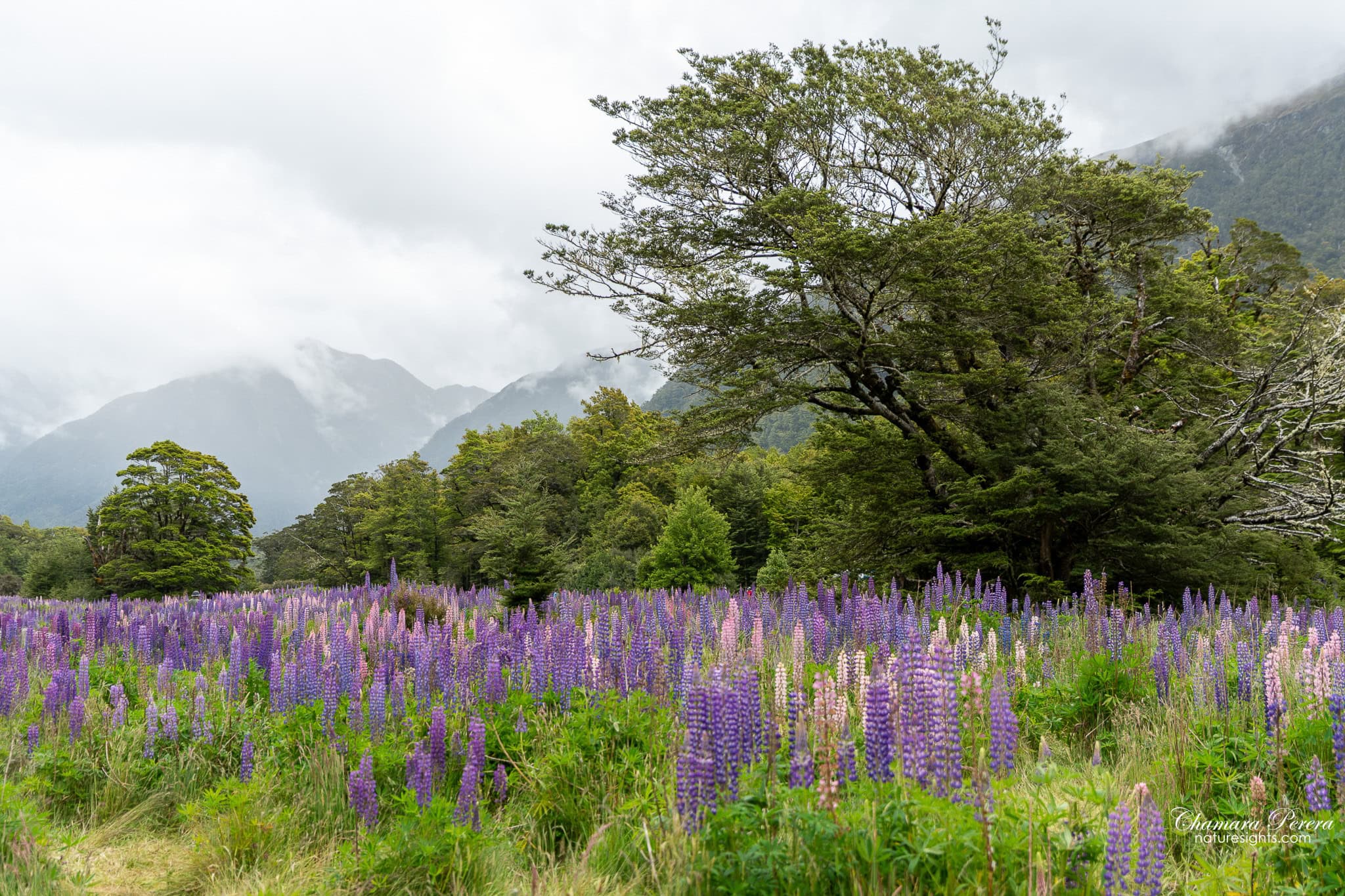
Further along, between roughly 30 and 60 kilometres from Te Anau, the Eglinton Valley opens into wide flat floodplains. This is where the lupins are, and I was not expecting them to be quite so striking.
Russell lupins are an introduced species in New Zealand and are considered invasive by DOC because they alter soil chemistry and crowd out native plants. That is a genuine problem. But from November through to January, the Eglinton Valley floodplains turn purple and pink and pale white with flowering lupins, and they are genuinely hard to drive past without stopping.

I pulled off at a flat area where a field of lupins stretched back towards the treeline with the mountains behind still draped in cloud. The flowers were mostly purple with some pink and cream mixed through, the spikes reaching about a metre tall. An old fallen log sat in the middle of the field. I shot that scene from several angles and spent longer there than I planned to.

I was there in overcast conditions, which actually worked well – soft light, no harsh shadows. The mountains were partly hidden in cloud but that added mood rather than taking anything away from the shot.


One thing to know: the lupins are not consistent along the whole valley. They cluster near roadsides and disturbed ground. Keep watching both sides of the road through the Eglinton Valley and stop wherever you see a good concentration.
Mirror Lakes
Mirror Lakes is the most well-known stop on the road, about 56km from Te Anau. A short flat boardwalk leads from the carpark to a series of small still ponds where the Earl Mountains reflect in the turquoise water on calm days.

The colour of the water is the thing here. That same deep teal you see in the Cleddau River, but held still in a contained pool fringed with flax and sedge. When I visited, the mountain slopes above were clear enough to see snow patches near the tops, and the reflection was close to working.
The boardwalk is only a few minutes’ walk and completely flat. It gets busy with tour buses through the middle of the day. Get there before 9am or after 3pm and you will have more of the place to yourself. I was there mid-morning and shared it with a handful of other people, which felt manageable.

The reflections work best from the far end of the boardwalk, looking back up the valley. There is a leaning tree branch overhead that I used to create depth in a few shots.


On a perfectly still day the reflections look almost unreal. On a windy day the surface breaks up completely and you get nothing. That part is just luck on the day.
Lake Gunn
A little further along, I stopped at Lake Gunn – a larger, more open body of water sitting against a wide mountain backdrop. It feels different from Mirror Lakes: broader, quieter, with bog vegetation and sedge along the shoreline rather than flax.

The water is darker here and the place felt genuinely remote. No other cars when I stopped. There is a short nature walk that loops through beech forest around part of the lake, though I only had time to walk to the water’s edge and back.
The cloud had started to break by the time I reached Lake Gunn. Patches of blue were appearing over the mountains, and the ridgeline was partly lit. That gave a different kind of shot than the overcast drama of the valley earlier – wider, brighter, more open.
Photography on the Milford Road
The conditions change fast on this road, especially in summer when weather systems move through quickly. What I had at Mirror Lakes was completely different from what I had an hour earlier at the Cleddau.
For the lupin shots, overcast light is better than sun. Direct sun creates harsh contrast between the bright flower spikes and the dark mountain shadows behind them. A longer focal length lets you compress the lupins against the mountain backdrop behind them – that compression is what makes those shots work. I had the Tamron 70-200mm f/2.8 G2 on the Nikon D750 for the lupin shots, which was the right call.
Mirror Lakes needs calm air – wind kills the reflections completely. Get there early, before the tour bus schedule kicks in. Crouch low on the boardwalk to include the water’s edge in the foreground rather than shooting from standing height.
For the Cleddau River, a slower shutter speed – 1/10th to 1/4 second – smooths the fast-moving water without losing all texture. Brace against a boulder if you don’t have a tripod with you. The thin waterfalls on the mountain faces work at any shutter speed since they’re narrow and high-contrast against the rock.
The best light on the whole road, if you get it, is overcast with occasional breaks. That combination flattens the shadows for the flowers, keeps the mountains moody, and occasionally gives you a brief patch of direct light on the water.
Getting there
The Milford Road is sealed two-lane highway for its entire length. In good weather it is not a difficult drive. In winter or after heavy rain it can be affected by snow, ice and landslides, and the Homer Tunnel section can close. Check the NZTA and DOC websites before you travel, particularly from June through September.
Distance each way: 120km. Without stops, about two hours. With stops at the main spots, allow three and a half to four hours per direction.
The Homer Tunnel operates on a timed one-way system at certain times of day – check the schedule before you drive so you do not end up waiting longer than necessary.
The road is within Fiordland National Park and free to drive. No entry fees.
Best time to visit
Summer (December to February) gives the best chance of clear days and the lupins at full flower. The road is at its busiest over this period, particularly Christmas and New Year. Expect other people at Mirror Lakes and the main stops.
November is a good option – lupins are starting to bloom, crowds are lower than peak summer, and the mountains still carry snow. March can work well too – thinner crowds and the beech forest starting to turn.
Winter (June to August) can bring snow to the higher sections and road closures. The Homer Tunnel area is avalanche-prone. Check conditions from DOC every morning before departing from Te Anau if you travel in winter.
Practical tips
- Fill up with petrol in Te Anau – no fuel on the road between Te Anau and Milford Sound
- Bring your own food and water
- Toilets at Te Anau, Knob’s Flat (80km from Te Anau) and Milford Sound only – nowhere else
- Sandflies are bad at many of the stops along the road – bring repellent
- Keep your windows up near kea (alpine parrots) – they pull rubber seals off cars
- Check NZTA road conditions before leaving, especially after heavy rain
- Leave time for random stops. Some of the best spots along this road have no signs and no names.
Frequently asked questions
Where are the best stops on the Milford Road?
The main named stops are Mirror Lakes (56km from Te Anau), Lake Gunn (80km from Te Anau), the Hollyford Valley Lookout, the Divide, and the Cleddau Valley near Milford Sound. When lupins are in season, the Eglinton Valley floodplains are worth stopping for and are generally quieter than Mirror Lakes. The Cleddau River pullouts near Milford Sound are easy to miss but worth finding.
How long does it take to drive from Te Anau to Milford Sound?
Without stops, about two hours each way. If you plan to stop at the Eglinton Valley, Mirror Lakes, Lake Gunn and the Cleddau River, allow at least three and a half to four hours per direction. For a full day trip including a cruise, budget eight to nine hours total.
Are there toilet stops between Te Anau and Milford Sound?
Public toilets are available at Te Anau, at Knob’s Flat (approximately 80km from Te Anau) and at Milford Sound. There are no toilets at Mirror Lakes, the Eglinton Valley pullouts or most of the roadside stops. Knob’s Flat is the only option in the middle of the route.
Can you see lupins on the Milford Road?
Yes – the Eglinton Valley section has large lupin fields in summer, from roughly November through to January. DOC classifies lupins as an invasive species, but during peak season the fields turn purple and pink across the valley floodplains. Look for the flower spikes in the flat sections where the road runs alongside open meadows. December and early January are usually the best weeks.
Is the Milford Road safe to self-drive?
In good weather, yes. It is a standard two-lane sealed highway and not technically difficult. The Homer Tunnel is single-lane with a one-way timed system, so check the schedule to avoid a long wait. In winter, snow and ice can make sections difficult and DOC may close parts of the road after avalanche risk or heavy rain. Check conditions before leaving Te Anau.
The drive home was the highlight
I went into that day thinking the Milford Sound cruise was the point. An hour into the drive back, I was not so sure.
The lupins alone were worth stopping for half an hour. Mirror Lakes delivered on what every photo of it promises. And the Cleddau River – those turquoise bouldered banks I stumbled onto without knowing to look for them – ended up being what I kept thinking about on the drive back to Queenstown.
Do not rush the road. It has more going on than what you went there for.
