Standing on snow at around 2,500 metres above sea level, surrounded by the jagged peaks of the Southern Alps, with the Helicopter Line’s blue-and-red helicopter sitting on the ice behind me – that was the moment I knew Franz Josef Glacier was unlike anything else I’d done in New Zealand. I had been on the Columbia Icefield in Canada, so this was not my first time on a glacier. But Franz Josef is a different experience entirely.
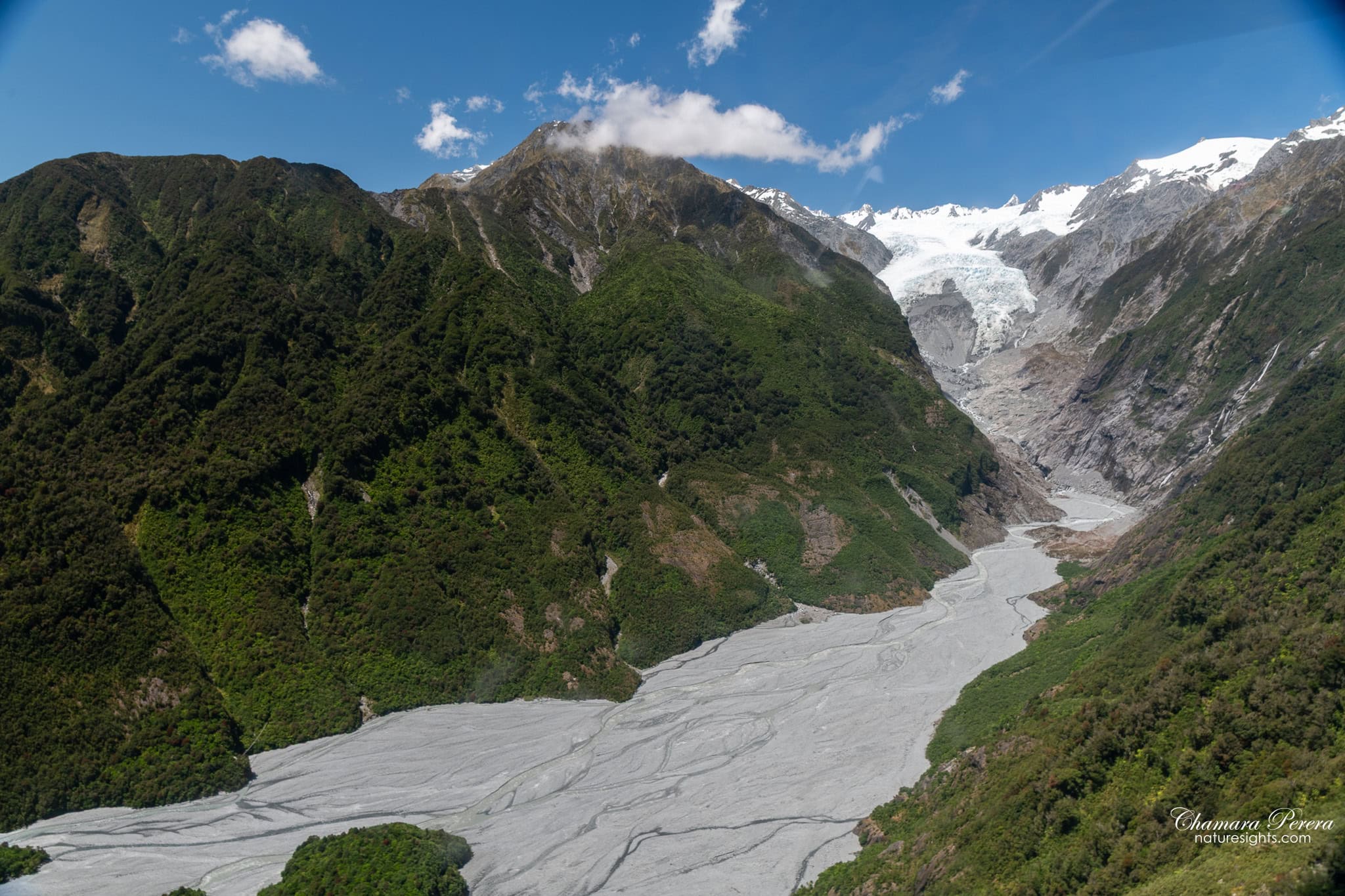
Franz Josef Glacier is one of the most accessible glaciers in the world. It sits in Westland Tai Poutini National Park on New Zealand’s West Coast, about five hours south of Christchurch by road. The glacier descends 12 kilometres from its neve – the high snowfield where ice forms – at roughly 2,700 metres down to around 300 metres above sea level. That is one of the steepest descents of any glacier in the country. On clear days you can see it from the village. On cloudy days, which happen often on the West Coast, the mountain disappears entirely and the flights do not go.
That is the catch with this place. Everything depends on the weather.
What makes Franz Josef Glacier special
The glacier is part of the same icy mountain system as nearby Fox Glacier, about 25 kilometres to the south. Together they sit in a World Heritage Area that covers 1.2 million hectares of Westland Tai Poutini National Park, stretching from the Southern Alps down to the coast where kahikatea rainforest grows right to the valley floor.
What makes Franz Josef unusual is how far it comes down. Most glaciers in the world stay at high altitude. This one pours down through a dense temperate rainforest. Stand at the valley floor lookout and you can see green native bush on one side and blue-grey ice above it on the other. The contrast is real. It looks strange.
The glacier moves fast too. The main ice fall has been recorded at up to five metres per day. That movement creates the crevasses and seracs – those blocks and towers of fractured blue ice – that make it so dramatic from the air. On the way up in the helicopter I could see the lower icefall from directly above, all churned and cracked into shapes that look almost deliberate.

The helicopter snow landing
The only way to get on the glacier itself is by helicopter. Ground access was cut off years ago because the ice has retreated so far – the valley floor is now a kilometre or more of rock rubble between the car park and the ice face. Helicopter tours are the main experience here, and the standard option is a snow landing.
I booked through The Helicopter Line, which runs flights from both Franz Josef and Fox Glacier villages. The standard tour is a 20-minute flight that lands on either the Franz Josef or Fox Glacier neve – the upper snowfield where the ice is broad and flat. You spend some time on the snow before flying back, enough to walk around and take in the view properly.
The view from up there is something else. To the east, the ridgeline of the Main Divide stretches in both directions – snow and rock mixed together, peak after peak. The clouds were building to the west when we were up there, which actually made for better photos than a plain blue sky.
You are collected from near the tour office in the village. The flight up takes around 10 minutes. The whole experience from check-in to return is about 90 minutes.
If you are in Australia, check your NRMA or RACQ membership before booking – both offer discounted rates on the Helicopter Line snow landing, so it is worth checking before you pay full price.


Photography tips for Franz Josef Glacier
A CPL filter is the most useful piece of gear you can bring. The snow and ice reflect enormous amounts of light, and without a CPL it is easy to blow out highlights and lose all the texture in the ice. With it, you can hold the blue tones in the crevasses and keep detail across the snowfield.
On the glacier itself, mid-morning and late afternoon give the best light. Midday sun on white snow is flat and harsh. If you can get a morning flight – 9am or 10am – do it.
Gear I used: Nikon D850 with the Tamron SP 24-70mm f/2.8 G2. I had the 70-200 G2 with me but left it in the bag – the 24-70 handled everything from the wide snowfield shots to the peak details well enough. In hindsight the 70-200 would have been worth pulling out to compress the distance to the ridgeline.
From inside the helicopter, shoot through the side window when possible. Vibration affects sharpness, so use a shutter speed of at least 1/1000s even in bright conditions.
When you land on the glacier and the sun is overhead, the light bouncing off the snow is intense. Sunglasses are not optional up there. Bring a good pair.


How to get there
Franz Josef village is on State Highway 6 on the West Coast of the South Island. Nearest airports:
- Hokitika: 115 km north (about 1.5 hours)
- Queenstown: 375 km south (about 4.5 hours)
- Christchurch: 490 km north-east (about 5 hours)
Most visitors arrive by rental car as part of a South Island road trip. The drive south from Greymouth along the coast is one of the better West Coast drives – you pass through the Paparoa National Park section and the Pancake Rocks at Punakaiki before reaching Glacier Country.
Fox Glacier village is 25 km south of Franz Josef on the same highway, about 25 minutes by road.

Best time to visit
Summer gives the longest days and the most stable flying weather. December through February is when you are most likely to get a clear morning window. Tour numbers peak in January and February, so book flights ahead. Winter can produce excellent clear days with crisp visibility, but the West Coast takes more Tasman weather fronts through June to August and cancelled flights are more common.
December and January mornings are the best combination if you are there to photograph.
Regardless of when you go, allow two full nights minimum. The West Coast is one of the wettest parts of New Zealand. Flights cancel for full days and then open up perfectly the next morning. Do not book one night and assume the helicopter will run.
Where to stay
I stayed at Fox Glacier Lodge in Fox Glacier village, about 25 km south of Franz Josef. A good base if you want to do the helicopter from Fox Glacier, or split time between both glaciers. The rooms were comfortable.
Book ahead in summer – it fills up. Fox Glacier Lodge on Booking.com
Franz Josef village has more accommodation options and is slightly larger, with more cafes and restaurants. Either works.

Practical tips
Layers are non-negotiable on the glacier snowfield, even in summer. At 2,500 metres the wind chill drops fast. A thermal base layer, a fleece, and a wind shell is the minimum. Sunscreen matters more than people expect – UV on snow at altitude is serious. Bring sunglasses too. The light reflected off the snowfield is harsh from the second you step out of the helicopter.
Flights cancel without much notice when the weather closes in. The day-before forecast is worth checking, but even that is not fully reliable up here. Stay flexible and plan for a second day. Operators will reschedule where they can, or refund where they cannot. A tight single-day itinerary built around a glacier helicopter will frustrate you.
NRMA and RACQ members can access discounted rates on the Helicopter Line snow landing – worth checking before you book.


FAQs
Is it worth visiting Franz Josef Glacier?
Yes, if you are doing the South Island. The helicopter cost is real but so is the experience – you are standing on active ice above the cloudline with the whole Southern Alps ridgeline around you. There is nothing quite like it in New Zealand.
Why is Franz Josef Glacier so special?
It descends through temperate rainforest, which almost no glacier in the world does. From the air you can see green bush on one side and blue ice above it on the other – the contrast is real. The glacier also moves fast – up to five metres a day at the icefall – which creates the crevasse formations that make it so photogenic from the air.
What time is best to see Franz Josef Glacier?
Morning. West Coast afternoons tend to cloud over as moisture builds from the Tasman. A 9am or 10am flight gives you the clearest conditions and better light on the ice.
Where is better to stay – Fox Glacier or Franz Josef?
Both are small villages about 25 minutes apart on the same highway. Franz Josef has slightly more going on. Fox Glacier is quieter. I stayed at Fox and found it fine. Either works since The Helicopter Line runs from both.
How many days should I spend at Franz Josef Glacier?
Two nights is the right call. One full day can go to weather without warning, and it happens regularly. Two nights gives you the backup day without the stress.
I did not expect to stand on a glacier on that trip. Franz Josef was not originally on my itinerary for the South Island – I added it late and it turned out to be one of the best decisions of the whole trip. If you are planning a South Island route, build it in and give it at least two nights so the weather does not make the decision for you.
More from my New Zealand travels: New Zealand travel guides
