Everyone talks about the four-day Milford Track. The permit lottery, the huts, the 53km end-to-end through one of the most celebrated wilderness corridors in the world. What gets mentioned far less is that you can walk part of this track in a single day – no permit, no pack, no scramble for a Great Walk booking. I did the Milford Track day walk from Te Anau in December through Fiordland Outdoors, and it was one of the standout days of my New Zealand trip.
The boat ramp on Lake Te Anau is where it begins. You drive there from town, step onto a small vessel, and 45 minutes later you’re at Glade Wharf looking at the actual start of the Milford Track. The mountains close in overhead. The Clinton River runs beside the trail in a shade of green you won’t see replicated anywhere else. Sandflies find you within seconds of stopping. It’s all exactly as good and as real as it sounds.

What is the Milford Track day walk?
The Milford Track runs 53km from Glade Wharf at the head of Lake Te Anau through to Sandfly Point near Milford Sound. The full route takes four days and requires a Great Walk permit that books out months ahead.
The day walk option cuts out the permit system entirely. You access either end of the track and walk in as far as you want, then return the same way. No hut bookings. No permit. No multi-day commitment.
There are two access points for day walkers.
The Te Anau end – where I went – starts at Glade Wharf, the official beginning of the track. A boat takes you across Lake Te Anau to get there. From Glade Wharf you follow the Clinton River valley through beech forest on a flat, easy trail. This is where Fiordland Outdoors runs their day walk operation.
The Milford Sound end is a different experience – and by most accounts, the better one. You get to the trailhead by water taxi from Sandfly Point, which is right next to the Milford Sound wharf. From there you walk inward through wetlands and open forest with views back toward the fiord. Giant Gate Falls is the landmark on this section – a wide drop straight into a clear pool, sitting right beside the trail. It is one of the more dramatic waterfall encounters on the whole track, and day walkers from the Sandfly Point end reach it without covering huge distance.
If you are already planning a visit to Milford Sound for the cruise, pairing it with the Sandfly Point walk on the same trip makes a lot of sense. The water taxi from the wharf is quick and the walk puts you through the most dramatic section of the lower track. I chose the Te Anau end because I was staying there and the logistics were simpler. But if you are doing the cruise anyway, the Milford Sound end is the one worth choosing.
How to book
Book the Milford Track day walk through Fiordland Outdoors via Klook. The package covers the boat transport across Lake Te Anau both ways. You walk at your own pace and turn around whenever you want.
Book well ahead. The boat has limited capacity and December is peak season. I booked several weeks in advance and there were still spots, but I wouldn’t leave it to the last minute.
The walk runs during Great Walk season – late October through April. Outside those months, the boat doesn’t operate.
Getting to the boat ramp
From Te Anau township, drive to the boat ramp on Lake Te Anau. It’s a short drive from town. Fiordland Outdoors gives you the exact address and departure time when you book – just follow their instructions.
The ramp itself is a metal pontoon on the lake edge. Functional and unglamorous. You board the boat here and the crossing begins.

The lake crossing
Lake Te Anau is New Zealand’s second-largest lake and the crossing to Glade Wharf takes roughly 45 minutes. On the December morning I did it, the lake was close to flat calm. The Southern Alps build ahead of the boat as you push deeper into the fiord, and on a calm day the reflections can be extraordinary.

A few kilometres in, the lake narrows. Forest comes right to the water’s edge on both sides. The mountains are higher and closer. The light was soft and overcast when I crossed, which made the lake surface almost perfectly reflective – clouds and ridgelines mirrored so precisely that the horizon line between mountain and water disappeared.


Walking the track: the Clinton River valley
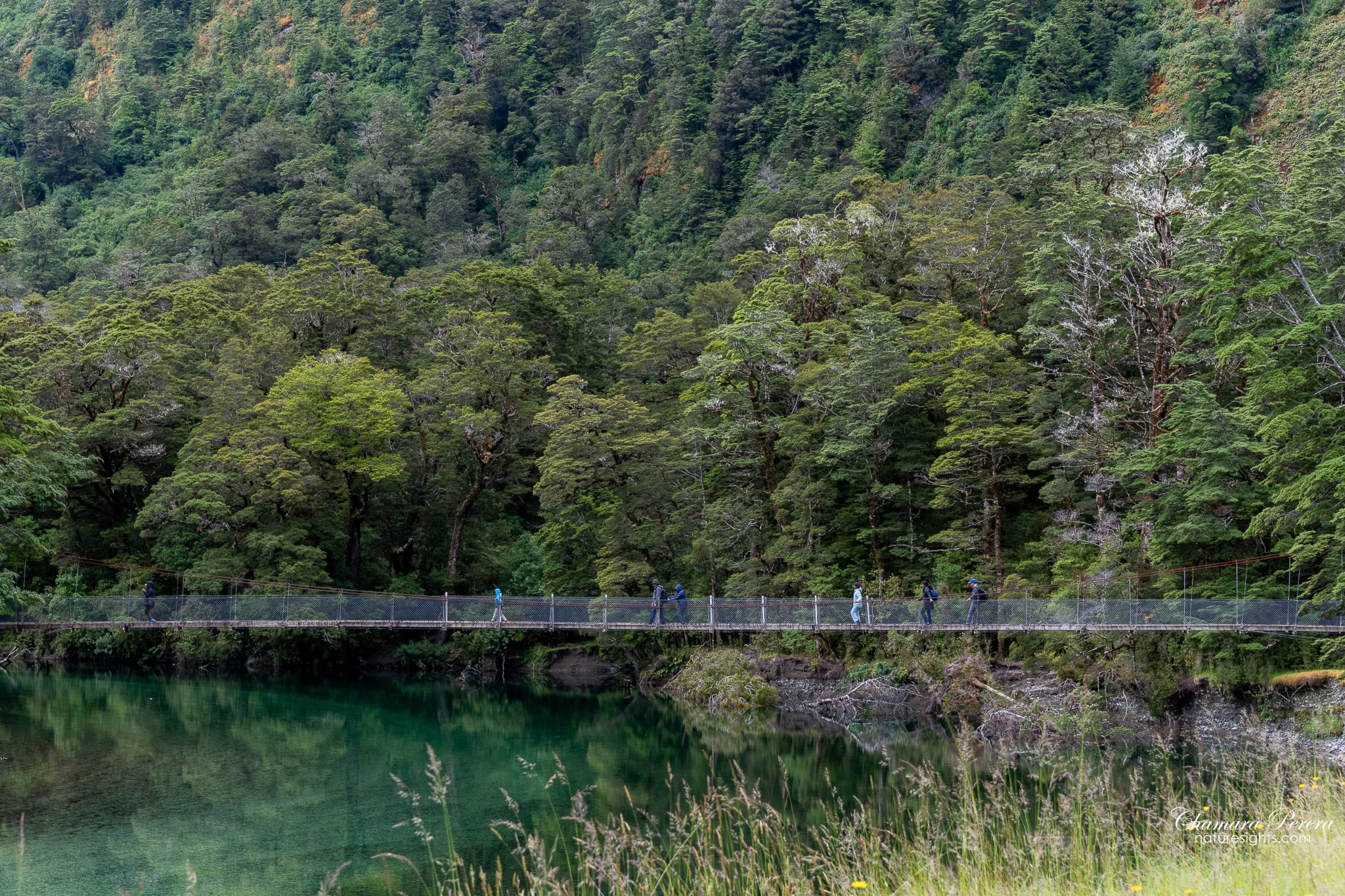
From Glade Wharf the track heads straight into beech forest and follows the Clinton River. The colour of the water stops you almost immediately – jade to turquoise depending on depth and light, clear enough to read the riverbed in two metres of water. The Clinton drains glaciated terrain above, and rock flour in suspension does the same trick as Hokitika Gorge: bending the light into that blue-green range that looks artificially vivid in photos but turns out to just look that way in real life too.

The trail is flat and wide. Well-formed gravel and dirt, no significant climbing on this lower section. You’re on the valley floor, the track staying close to the river most of the way, beech forest draped in moss and lichen on both sides. The trees are massive. The forest has been growing undisturbed in this wet, sheltered valley for a long time and it looks it.
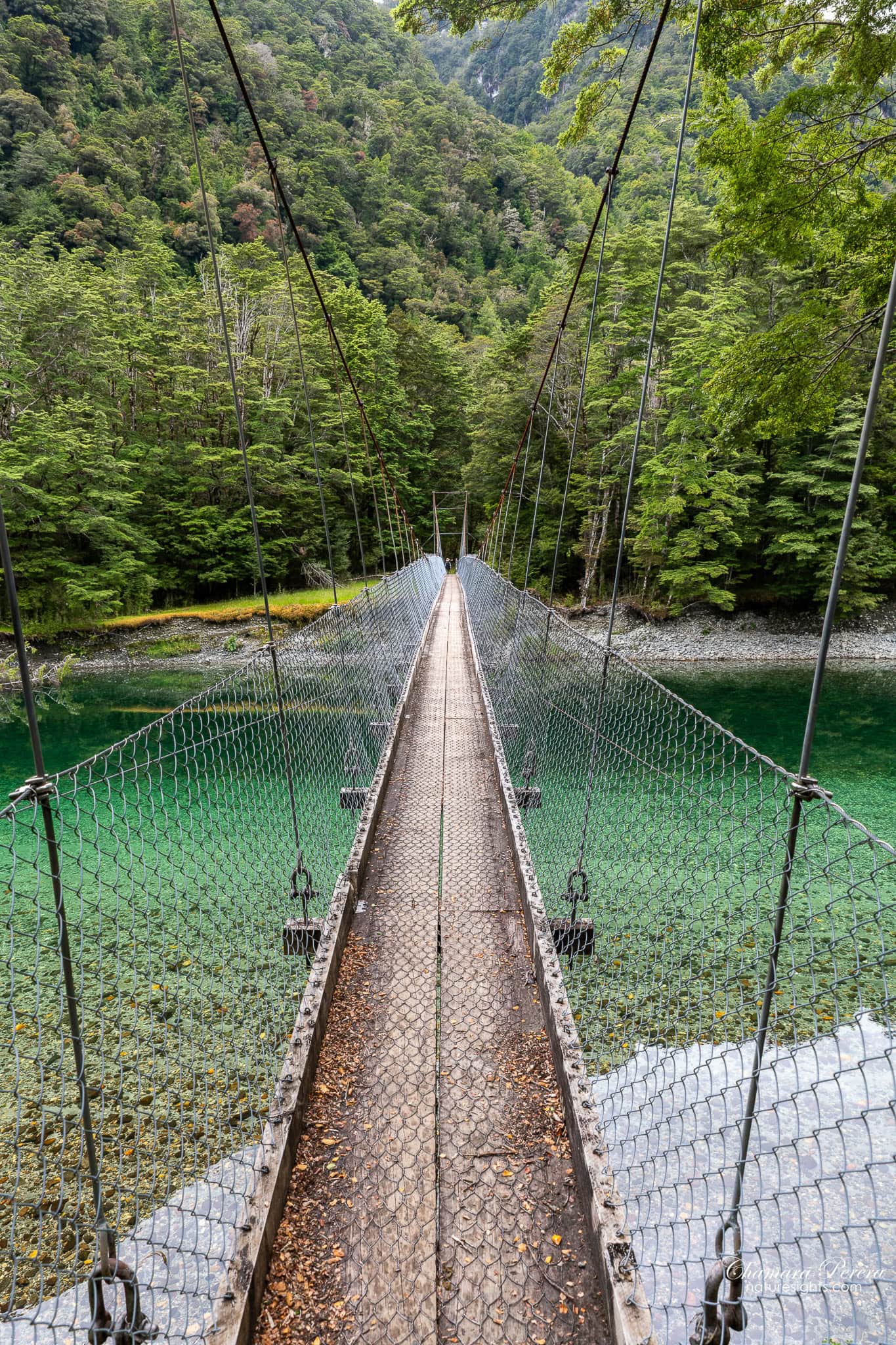
The first swing bridge comes after roughly a kilometre. Standing over the water looking downstream, the river runs deep and still under the planks and that green colour is strongest where the water is deepest. This is the most-photographed spot on the Te Anau end. Get there early before the rest of the group.


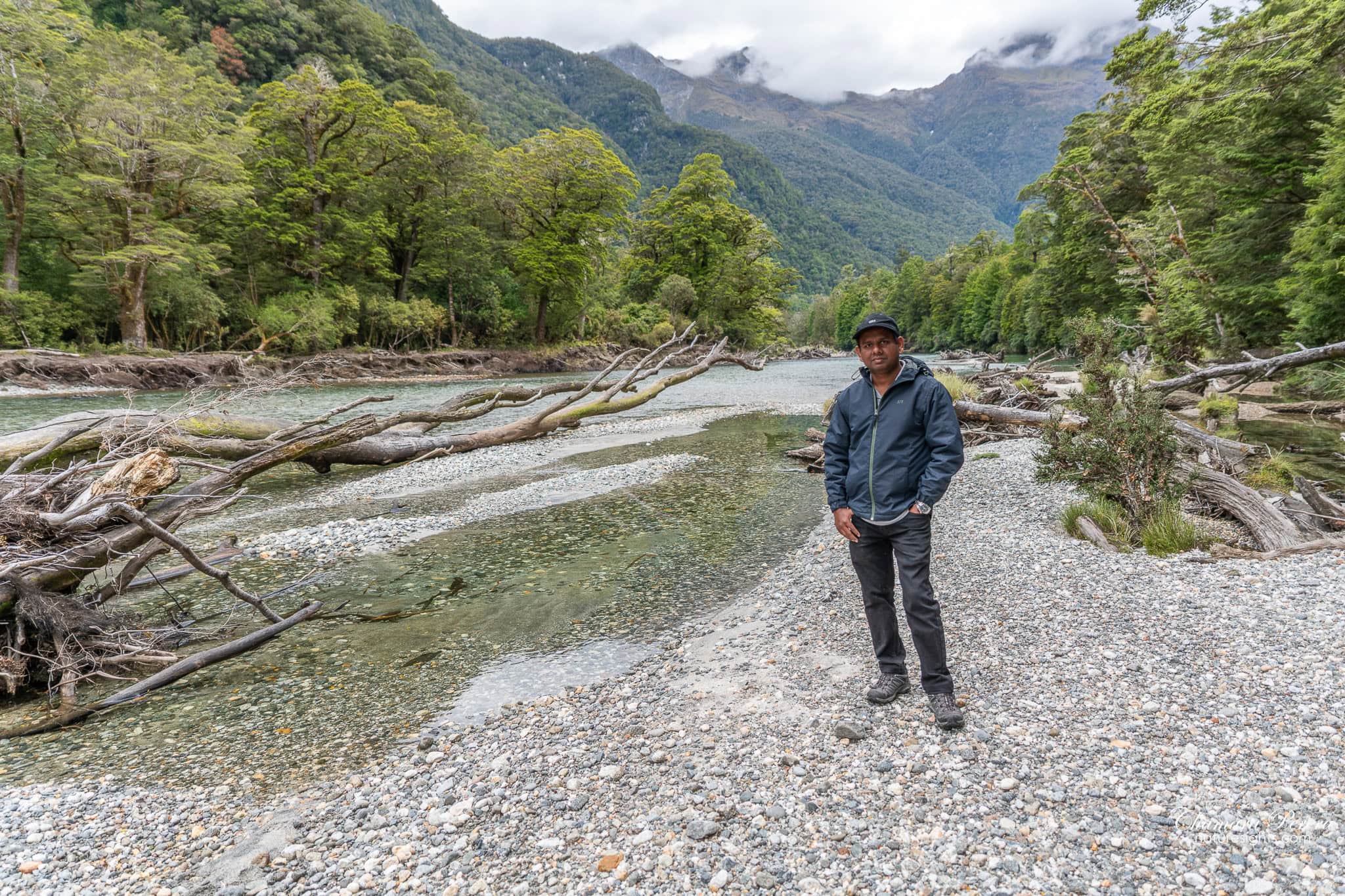
Around 2km in you reach Glade House, the first hut of the Great Walk route. Day walkers pass through but don’t stay. Just past the hut the valley opens slightly and the Clinton spreads across a wide shingle bed – rounded boulders filling the river channel, driftwood piled where floods have left it, mountains visible through gaps in the canopy with cloud sitting over the ridgelines.
I ate lunch on the rocks in the river bed. Wide sky, views up the valley, nowhere in particular you need to be.


Wildlife on the walk
I did not expect to find a morepork in the middle of the day. Morepork – ruru in Maori – are nocturnal owls. They don’t come out during daylight hours. But walking through beech forest maybe a kilometre from Glade Wharf, one was sitting on a mossy branch about three metres off the track, watching me with complete composure.
I nearly walked straight past it. When I stopped and looked back, there were those round yellow eyes. I got a few shots with the Nikon D850 and Tamron 24-70mm before it quietly dropped off the branch and disappeared into the forest. The whole thing took maybe two minutes.

Weka were along the track from start to finish. These big flightless birds are completely unbothered by people. They fossick through the leaf litter right beside the track and will come within a foot of your boots if you stop. They’re not dangerous. They just don’t move out of your way. Don’t feed them.


Tomtits worked the mossy trunks throughout the beech forest. Small, quick, black and white. They move fast between branches but will come reasonably close when feeding. A longer lens helps.

The sandfly problem
Sandflies in Fiordland in December are a problem, not a minor inconvenience. At Glade Wharf and along the Clinton River they are constant.
While you’re walking they mostly leave you alone. The moment you stop – to photograph something, to look at the river, to pull out your map – they’re on every exposed piece of skin. My forearms copped the worst of it each time I stopped to shoot. I’d set up a composition and feel them landing before I’d even focused.
Cover up more than you think you need to for a summer day. Long sleeves, a collar you can turn up, and the strongest DEET repellent you can find in Te Anau before you go. Apply it before you step off the boat, not after you arrive and start noticing the bites. Fiordland Outdoors will mention sandflies at the briefing. They’re not exaggerating.
Photography tips
The Clinton River is the main subject for most of the walk. The swing bridges give the clearest views down the river with forest closing in on both banks. Get to the first bridge early before the group catches up with you. Mid-morning the light goes flat under cloud cover, but overcast conditions actually help with the water colour – no harsh reflections breaking up the surface.

For the morepork shot I got, it was luck and moving slowly through the forest rather than walking quickly between viewpoints. The Nikon D850 with the Tamron 24-70mm is not ideal for wildlife at distance, but the owl was close enough that it worked. If you carry a longer lens, take it. The forest is dark so you’ll need it to be fast.
For weka: don’t follow them. Stop and wait. They come back to you.
Shoot from the boat during the lake crossing – from the bow or stern rather than the side windows. The Alps fill the frame ahead as you approach Glade Wharf. If conditions are calm the reflection shots are some of the best images from the whole day.
One practical note on photography and sandflies: they bite while you’re composing a shot. You will notice this. Set up, shoot, move.
How to get there
Te Anau is the base town for the day walk.
From Queenstown it’s roughly 2.5 hours by car – State Highway 6 to Mossburn, then SH94 south to Te Anau. InterCity runs daily buses from Queenstown if you’re not driving.
From Milford Sound it’s 2 hours back down SH94. If you’ve done the Milford Sound cruise, Te Anau is the natural overnight stop. You can also read about the key stops on the drive from Te Anau to Milford Sound if you’re planning both.
Fiordland Outdoors sends you the exact meeting point and departure time when your booking confirms.
Best time to visit
The day walk runs from late October to late April during Great Walk season.
December through February is summer – longest days, best weather odds, most people, worst sandflies. I went in December and had soft overcast light for most of the day, which was actually good for photography.
October and November are quieter, cooler, and the forest looks fresh after spring. The weather is less predictable but the track isn’t crowded.
March and April are significantly quieter. The autumn light is good and the temperatures are comfortable. Weather windows are narrower but if you get a clear day it’s worth it.
Rain is possible any time in Fiordland. The weather changes fast and the forecast is often wrong. Always carry a waterproof jacket.
Where to stay in Te Anau
Te Anau has a good range of accommodation – motels, backpacker hostels, and holiday parks. Book it when you book the walk. In December and January it fills quickly and options get limited fast if you leave it late.
Practical tips
Buy insect repellent in Te Anau before you go – the strongest DEET formulation you can find. Don’t assume you’ll get a good one on the track. Long sleeves even in summer. A waterproof jacket because Fiordland weather doesn’t give you warning. Lunch and water, because there’s nothing to buy on the track. Trail runners or walking shoes are fine for this section – the surface is good and the terrain is flat. If you have a longer lens for wildlife, pack it.
On distance and timing: the boat crossing is 45 minutes each way. From Glade Wharf to Glade House is about 2km, roughly 30 to 40 minutes at a walking pace. Most people cover 4 to 10km total before turning back. The track is completely flat so your turnaround point is really just a matter of how long you want to be on your feet.
FAQs
Can you do a day walk on the Milford Track?
Yes. Fiordland Outdoors runs a day walk from the Te Anau end of the track. Their boat takes you across Lake Te Anau to Glade Wharf – the start of the Milford Track – and you walk at your own pace from there. No permit is required for day walkers on this section. Book via Klook.
You can also walk the Milford Sound end as a day walk, using a water taxi from Sandfly Point near the Milford Sound wharf. That section covers different terrain – wetlands, open forest, and Giant Gate Falls – and is worth considering if you are combining the walk with a Milford Sound cruise on the same trip.
How difficult is the Milford Track day walk?
The Te Anau end section is flat and easy. The trail is well-maintained gravel and dirt with no significant climbing on this lower section. Children and older walkers handle it without issues. The sandflies are genuinely the hardest part.
What is the best time of year to do the Milford Track day walk?
The walk runs October through April. October and November are quieter with fresh spring conditions. December through February has the best weather odds but the most visitors and worst sandflies. March and April are much quieter and the light in autumn is good. Rain is possible in any month – pack accordingly.
Are there sandflies on the Milford Track?
Yes, and they’re significant, especially in summer. Cover up, apply strong repellent before you step off the boat, and keep moving between photo stops. Standing still is when they find you.
How do you book the Milford Track day walk from Te Anau?
Book through Fiordland Outdoors via Klook. The package includes boat transport across Lake Te Anau both ways. Book as far ahead as you can – spots on the boat are limited and peak season fills up fast.
