The Hooker Valley Track keeps improving as you go. I’d heard the name before arriving at Aoraki/Mount Cook, seen it in every South Island itinerary I’d read, and by the time I pulled into the White Horse Hill car park I’d already heard two other travellers mention it at breakfast. After doing it, I understand why. The track is easy, it’s free, and it ends at a glacial lake where icebergs are just floating there in front of you.

We stayed in Lake Tekapo the night before and drove up the next morning – about 1.5 hours. Our first attempt was the evening we arrived. Grey skies, light rain, Mount Cook completely hidden behind cloud. We turned around, had dinner at the village, and went back first thing the next day. Good call. The cloud had lifted overnight and the conditions were completely different – the full Southern Alps ridge showing, the glacier faces clear, the peaks out. If you’re in the area and the weather is bad, wait. One clear morning on this track is worth two rainy attempts.

What is the Hooker Valley Track?
The Hooker Valley Track is a 10km return walk inside Aoraki/Mount Cook National Park on the South Island. It’s the most popular short walk in the park and the reputation is fair. The grade is easy, the track surface is well maintained the whole way, and the scenery gets better with every 500 metres.
The track starts from the White Horse Hill campground car park, crosses three swing bridges over the Hooker River, passes Mueller Lake, and finishes at Hooker Lake at the base of the glacier. Total elevation gain is around 100m. Most people complete the full return in 3 to 4 hours.
Note on current track status: As of mid-2026, one of the three swing bridges is temporarily closed for a replacement structure. The track currently ends at the Kakīroa/Mount Sefton View Lookout rather than Hooker Lake. A new suspension bridge is expected to open around late July or early August 2026. When I walked the track, all three bridges were open and the route to Hooker Lake was fully accessible. Check the DOC website for current status before visiting.
Driving in from Lake Tekapo
The drive from Lake Tekapo to Mount Cook takes about 1.5 hours on State Highway 80 – a dead-end road running straight into the mountains with open tussock country on either side. You can see the park from a long way out. The mountains build gradually in the windscreen and then fill it completely once you reach the final flat stretch. There are several one-way bridges on the road in, so watch for the give-way signs.

The Tasman Valley Road turn-off is signposted on the right, about 3km before the village – worth a separate stop for Tasman Glacier views. For the Hooker Valley Track, keep going to the White Horse Hill car park at the road’s end.

On the morning we went back, the whole range was visible from the moment we turned onto State Highway 80 at Tekapo. Same mountains, completely different experience to the previous evening.
Starting the walk

The track opens on a wide gravel path through open tussock flats. Firm surface, well graded throughout – no scrambling, no steep sections, nothing that would cause problems for anyone reasonably fit. The first 20 minutes are fairly flat, walking across the valley floor with mountain walls on both sides.

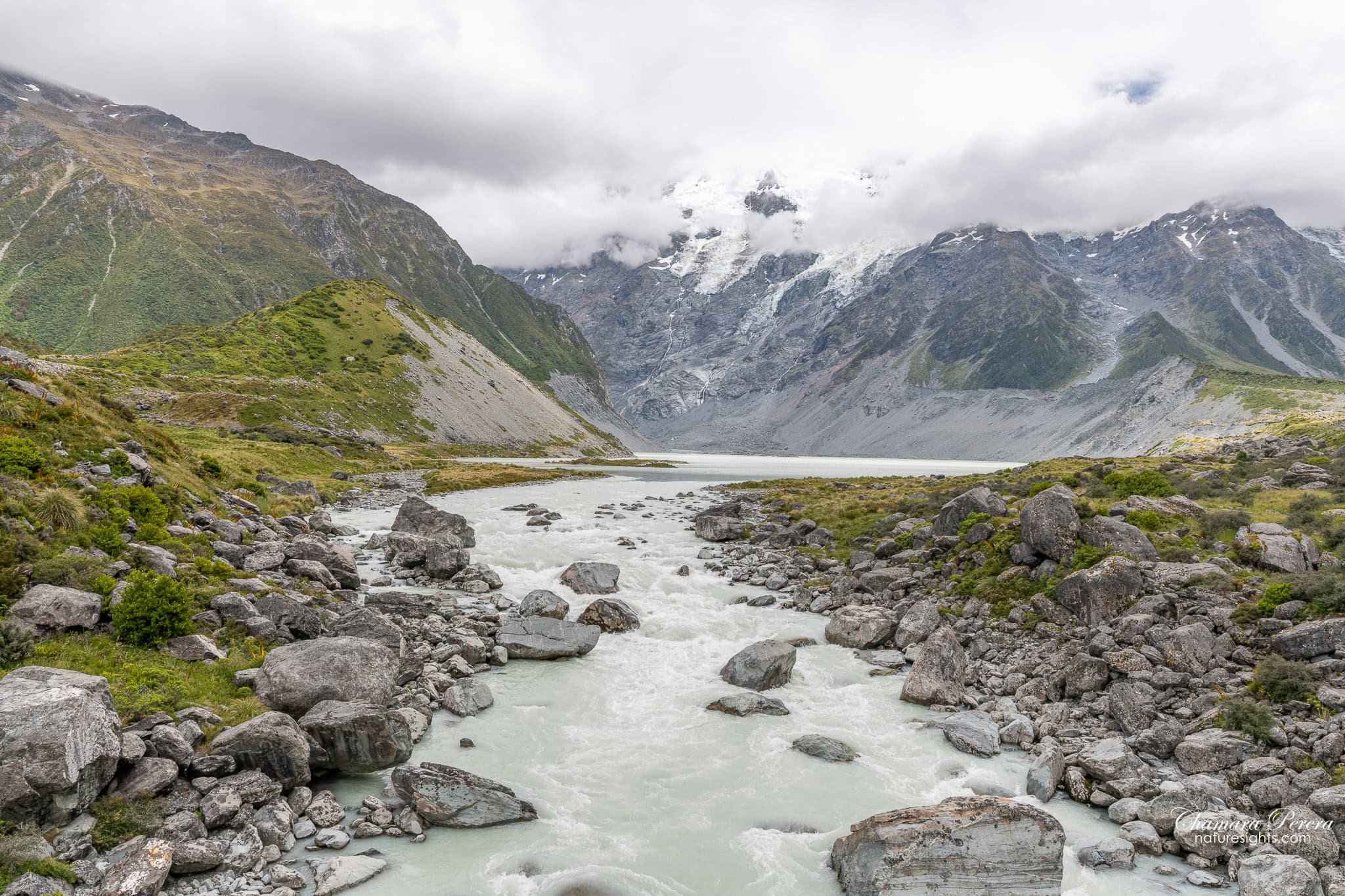
The two sides of the valley look nothing like each other. To the left, low green scrub and tussock grass. To the right, bare moraine – grey scree and rock rubble left behind as the glacier has retreated. You notice it within the first few minutes and it doesn’t really go away.


Mueller Lake
About 1.5km in you reach the first viewpoint above Mueller Lake – a stone-walled lookout with a DOC information board. A lot of people stop here, take their photos and turn back. It’s a good spot, but it’s not the best part of the walk by some margin.

Mueller Lake is milky green from glacial flour – fine rock particles ground up by the glacier and suspended in the water. The DOC board explains how the lake formed as the Mueller Glacier retreated up the valley. What you’re looking at from the viewpoint is the remnant of a much larger glacier that used to reach down to where the track runs now. The glacier face is still visible on the mountain above, a band of blue-white ice cutting through the grey rock.


From the viewpoint the track continues around the edge of the moraine ridge. It narrows a little and the glacier comes into better view.


The swing bridges
There are three swing bridges on the full route, each crossing the Hooker River at a different point. Each bridge has a limit on how many people can be on it at once – the number is posted at each end.

The first one puts you above the river with a view in both directions – downstream over the moraine flats, upstream toward the mountains. The second bridge is higher and longer. From the approach you get a view over the whole lower valley, the river threading below, the lake beginning to show through the scrub ahead.


The third bridge is the one just before Hooker Lake. When I crossed it there was a queue of people on both sides. Once you’re over, the lake is only a few minutes away.
One of these bridges is now closed while DOC builds a permanent replacement. The new suspension bridge is expected to open around late July or early August 2026. When I visited, all three were open and the full route was walkable.
Wildlife and alpine plants
Lower in the valley it’s tussock grass and low scrub. Higher up, shorter alpine plants and patches of bare rock. In summer, mountain daisies grow through the grass – small white flowers with yellow centres, some on tall single stems.

There are clear alpine streams running off the slopes at several points – clean, cold water flowing over pale grey rock.


Approaching Hooker Lake
The upper section feels different to the lower valley. The scrub thins out, the rock is more exposed, and the glacier is close enough that you can see individual crevasses in the ice. The Hooker River here is milky grey-white and moving fast over a wide rocky bed.

There are several stream crossings on small bridges before you reach the final swing bridge, and some sections where the path narrows between boulders. Still easy walking, but rawer than the tussock flats at the start.


The river flows out of Hooker Lake through a shallow gorge just before the final bridge. From the bridge you can see the lake opening up ahead.


Hooker Lake
The track ends at the shore of Hooker Lake, where the river enters from a rocky fan on the left. The lake is backed by the wall of the Hooker Glacier. When conditions are right, icebergs calve off the glacier and float down into the water.


When I arrived, two icebergs were sitting about 50 metres from the shore. Blue-white, irregular shapes, completely still on the grey-green water. Mountain walls on three sides, the glacier face above. I stood there a good while longer than I intended to. At one point I heard a deep cracking sound from the glacier – ice shifting and breaking somewhere up in the face.


The icebergs aren’t guaranteed on any given day – it depends on the calving cycle and how recently ice has broken off. On my visit they were clearly visible from the shore. Some days there are none, other days more. Checking recent visitor photos online before you go gives a rough idea of what to expect.


A few people were sitting on the boulders near the shore having lunch. Some were walking the shoreline to find better angles. The lake is cold – I didn’t wade in, though a couple of people did.
Photography tips
I shot the full walk with a Nikon D850 and Tamron 24-70mm f/2.8. That focal range covers everything here well – wide enough for the valley panoramas and the Mueller Lake viewpoints, and the 70mm end compresses the glacier faces nicely.
The mountain range runs roughly north-south. Morning light hits the glacier side from the side rather than front-on, which gives better texture and depth than midday.
For the swing bridges, shoot from the approach before you cross rather than from the bridge itself. You get the full bridge span with the valley and mountains behind it, and you’re not dealing with the bridge swaying while you try to compose.
Mueller Lake photographs well in overcast. The milky green colour comes through better without harsh sun on the water. The stone viewpoint wall in the foreground gives depth.
At Hooker Lake, the icebergs drift slowly as the wind shifts. If the position isn’t working when you first arrive, walk the shoreline in both directions. Portrait format works well here – you get the iceberg, water, glacier face and sky in one frame without too much empty foreground.
The overcast conditions I had turned out to be ideal. No harsh shadows, good colour in the water and rock, the clouds added depth to the mountain shots. A clear day is better for actually seeing Aoraki/Mount Cook, but overcast is often better for the camera.
How to get there
Aoraki/Mount Cook National Park is in the Mackenzie Basin on the South Island. Main routes in:
- From Christchurch: approximately 3.5 hours via State Highway 1 and State Highway 8 through Tekapo
- From Queenstown: approximately 2.5 to 3 hours via State Highway 8 through Twizel
- From Lake Tekapo: approximately 1.5 hours via State Highway 8
The road into the park is a dead end. Fill up with fuel before Twizel – there’s no petrol at the village.
The Hooker Valley Track car park is at White Horse Hill, about 3km past the village. No parking fee. No entry fee.
Best time to visit
Summer (December to February) is peak season – longest days, warmest temperatures, wildflowers on the track. The car park fills early; arriving by 8am is not an exaggeration.
Shoulder season (October-November and March-April) is quieter, with better light for photography. Spring can have more snow on the peaks, which photographs well.
Winter (June to August) is cold and short on daylight. The track can have icy patches. But a clear winter day at Mount Cook has excellent light and far fewer people.
Whatever the season, check the MetService forecast specifically for Mount Cook rather than going by conditions at Tekapo or Queenstown. The park has its own weather. A clear morning 90 minutes away doesn’t mean a clear morning at the track.
Where to stay
Mount Cook Village has limited accommodation and it books out well ahead in peak season:
- Aoraki/Mount Cook Alpine Lodge
- The Hermitage Hotel (expensive but right there)
- White Horse Hill Campground (basic DOC-managed camping, very close to the trailhead)
Lake Tekapo, 1.5 hours away, has more options at lower prices. I stayed at Neptune Holiday House, a self-contained property in the village – comfortable, private, and a short walk from the lake. Drove up to the track in the morning, which worked well. The early start to beat crowds is easy when the accommodation is already 90 minutes from the car park anyway.
Practical tips
- Track length: 10km return (5km each way)
- Difficulty: Easy – well graded gravel path throughout
- Time: Allow 3 to 4 hours return
- Elevation gain: approximately 100m
- Entry fee: Free
- Car park: White Horse Hill, 3km past Mount Cook Village
- Toilets: At the car park and at the Mueller Lake viewpoint
- Track surface: Compacted gravel and boardwalk – trainers are fine
- Water: Bring your own. No food or water available on the track.
- Layers: The valley can be significantly colder than the village. Bring a windproof jacket even in summer.
- Start time: Early. The track gets busy from mid-morning on.
Frequently asked questions
Is the Hooker Valley Track currently open?
As of mid-2026, the track is partially closed. One swing bridge is under construction and the route ends at the Kakīroa/Mount Sefton View Lookout rather than Hooker Lake. DOC expects the new bridge to open around late July or early August 2026. Check the DOC website before visiting for the latest.
How long does the Hooker Valley Track take?
Most people do the full 10km return in 3 to 4 hours at a comfortable pace. If you walk quickly and skip the viewpoints, 2.5 hours is possible. I’d allow at least 3.5 hours to do it properly, including time at the lake.
Do you need to book or pay?
No booking required and no entry fee. The car park at White Horse Hill is first-come, first-served. In summer it fills by mid-morning.
What should I bring?
Good walking shoes or trainers are fine – the track surface is solid throughout. Bring warm layers regardless of what the forecast says, as the valley runs colder than the village. Carry water and food; there’s nothing available on the track.
Can you see Aoraki/Mount Cook from the track?
On a clear day, yes – the summit is visible from the upper section. When cloud covers the peaks, which happens a lot, you see the glacier faces and lower mountain walls clearly but not the top. Morning is generally clearer than afternoon, but there are no guarantees at Mount Cook.
Final thoughts
I’ve done a lot of South Island walks and this one holds up. The effort is low, the route is obvious, and what’s at the end – icebergs floating in a glacial lake at the foot of New Zealand’s highest mountain – is genuinely hard to prepare yourself for.
If you’re putting together a South Island road trip and debating whether to include Mount Cook, include it. Stay at least one night nearby, check the weather, and be on the track early on your best morning.
For more on driving through the Mackenzie Basin, my guide to driving Lindis Pass from Wanaka to Lake Tekapo covers the full route between those two towns. For another South Island hike worth adding to the trip, the Roy’s Peak walk at Wanaka is a harder day but the summit views are hard to beat.
