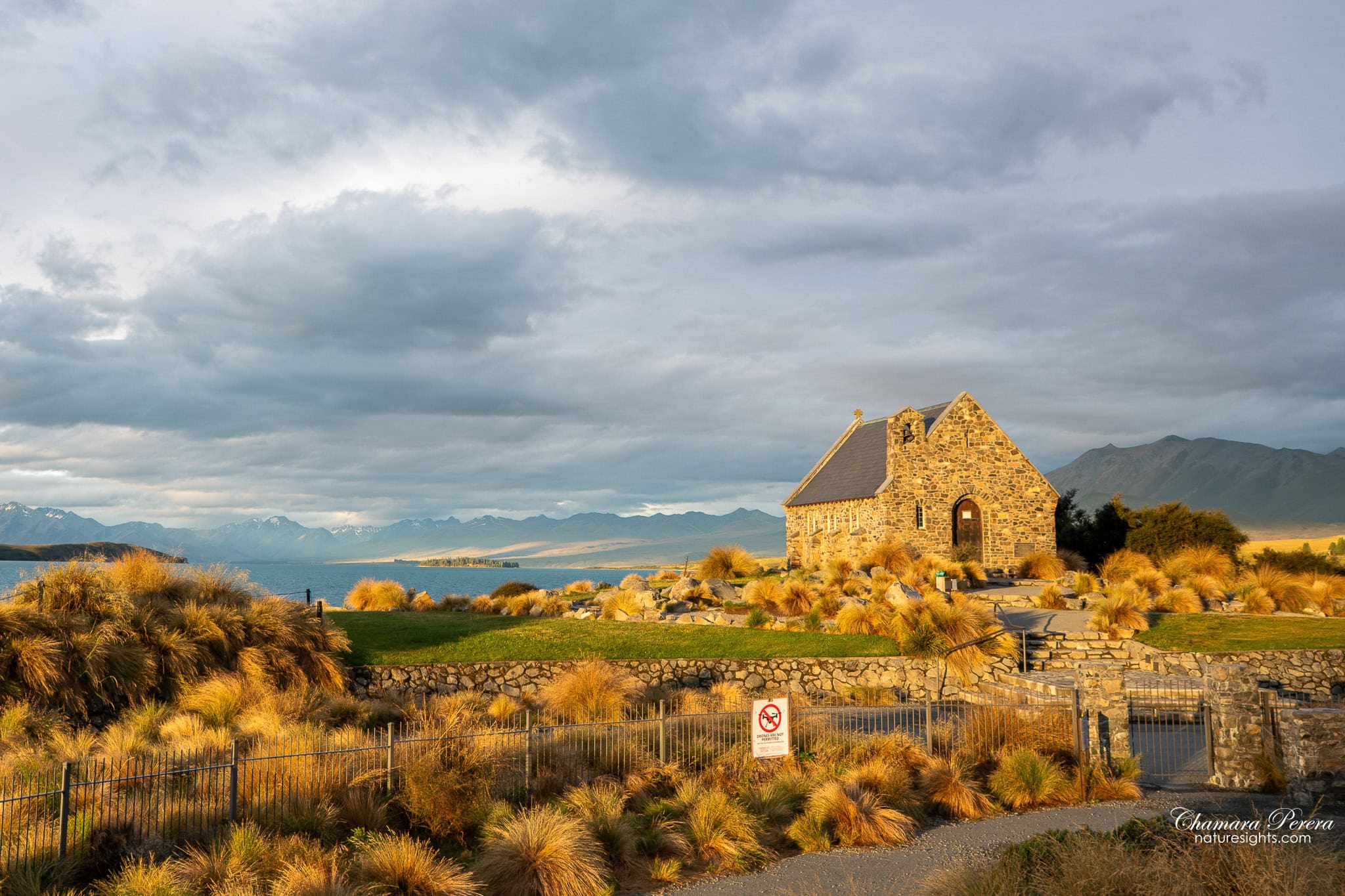
The drive from Wanaka to Lake Tekapo via Lindis Pass is one of those South Island roads that keeps changing on you. I left Wanaka and arrived at Lake Tekapo in time for a sunset that turned the Church of the Good Shepherd the colour of warm stone and copper. In between was one of the most dramatic alpine landscapes I saw on my whole New Zealand trip – and I nearly didn’t stop. If you’re making this drive, plan a few hours for it.

Overview
The route follows State Highway 8 from Wanaka, climbs over Lindis Pass at 971m, and drops into the Mackenzie Basin before reaching Lake Tekapo. The direct drive is roughly 201 kilometres and takes about two and a half hours with no stops. With stops – and there are several worth making – allow three and a half to four hours.
The landscape changes completely as you go. Wanaka sits in a valley ringed by rocky mountains. The Lindis Pass section is all rolling tussock-covered hills, almost treeless, with a very particular golden colour that shifts depending on the light. After the pass you’re in the wide flat Mackenzie Basin, with the Southern Alps stretched out along the western horizon. By the time you reach Lake Tekapo, you’re looking at turquoise glacial water and snow-covered peaks.
I drove it as a one-way leg as part of a longer South Island loop, coming from Queenstown through Wanaka. If you’re doing the same route, the Queenstown to Wanaka drive is a good warm-up for what comes next.
Lindis Pass New Zealand: what to expect on the road
The pass section starts about 50 kilometres east of Wanaka. The transition is gradual – farming country gives way to open tussock grassland, the road starts climbing, and the hills close in on both sides. By the time you’re in the middle of the pass, the landscape is just rolling golden hills, grey sky or blue depending on the day, and the white line of the highway threading through it.


The tussock is snow tussock (Chionochloa rigida), a native grass that grows at altitude across the South Island. It’s the reason the hills look that particular gold colour. In early morning and late afternoon light it almost glows.


The summit area has a small pullout on the side of the road. I stopped here and got out. The wind was cold and the road was quiet. I stayed longer than I meant to.


After the pass: Omarama and Twizel
Once you’re over the summit and descending, the hills flatten, the road straightens, and you’re into the Mackenzie Basin. The small town of Omarama is about 45 kilometres from the summit – worth a stop for fuel and coffee, and if you want to add 20 to 25 minutes, the Omarama Clay Cliffs are just off the main road and genuinely unusual.
Twizel is another 40 kilometres on. It’s the closest town to both Aoraki Mount Cook National Park and Lake Pukaki. Lake Pukaki is on your right as you drive north on SH8 – another turquoise glacial lake with Mount Cook at the far end on a clear day.
Both Omarama and Twizel have fuel and food. Twizel has more options. If you’re planning to stop at Lake Pukaki or take the detour toward Mount Cook, factor in the extra time – it’s about 50 kilometres from Twizel to the Mount Cook village.

The lupins are Russell lupins (Lupinus polyphyllus), introduced from North America. They’re not native and DOC has a programme to manage them, but along roadsides they persist. Peak season is roughly November through mid-December. By late December they can already be fading.
Arriving at Lake Tekapo
Lake Tekapo itself is immediately visible as you come into the village. The water is a turquoise blue that looks unreal – it comes from the glacial rock flour suspended in the water. The lake sits in a wide basin with the Southern Alps forming the western wall.

The Church of the Good Shepherd
The Church of the Good Shepherd sits on a rocky outcrop at the edge of the lake, about a five-minute walk from the main township. It’s a small stone building – hand-laid schist and granite, built by the local farming community in 1935. From the front it looks simple: an arched doorway, a small bell tower on one side, a wooden door. Walk around to the back and you see the lake and mountains through a large window behind the altar.


I arrived when the sky was still overcast and the church looked striking but flat. About an hour later the clouds shifted to the west and the sun came through at a low angle. The light hit the front of the church directly and the stone turned from grey to orange. That’s the shot everyone comes for.


The church is still an active place of worship. Services take place regularly, and if one is scheduled you won’t be able to enter. Photography inside the church is not permitted. Check the noticeboard at the gate for times. Outside of services, entry is free and the door is open.
Photography tips
For Lindis Pass, the best light on the tussock hills is early morning or late afternoon. The golden colour intensifies when the sun is low – midday light is flat and the hills lose their texture. A wide lens works well for the valley shots. I used my Tamron 24-70mm at the wide end for most of the pass photos. Pull over at the summit area and also at any of the informal layby spots on the descent – looking back up the valley from lower down gives a different angle than you get from the top.
For the Church of the Good Shepherd, come in the afternoon. The entrance faces away from the lake, so the front is in shadow in the morning – the sun is behind the church. From early afternoon onward the light swings around from the west and hits the front directly. Sunset light on a day with some cloud cover is the best combination – the cloud diffuses and warms the light without blocking it completely.
The viewpoint most people use is directly in front of the church on the footpath. For a wider perspective with the lake included, move back and to the left – you get more of the lake and the mountains behind the church.
The area around the church gets busy in peak season. If you want it without crowds, try early morning or just wait for tour groups to cycle through. Tripod use is restricted to outside the fenced area.
Lake Tekapo is in the Aoraki Mackenzie International Dark Sky Reserve. If you’re staying overnight, set an alarm for 2 or 3am and go outside. The Milky Way is very clear from here, and the church silhouetted against a night sky is one of the most photographed night shots in New Zealand.
How to get there
The drive from Wanaka to Lake Tekapo follows State Highway 8 the entire way. You don’t need a 4WD. The road is sealed and in good condition for most of the year. In winter the pass can be affected by snow and ice – check the NZTA website for road conditions before you drive in June through August.

From Queenstown, the drive to Lake Tekapo via Wanaka is around 310 kilometres and takes about four hours without stops. It’s a natural two-day combination – overnight in Wanaka, then drive to Tekapo the following day.
From Christchurch, Lake Tekapo is about 225 kilometres southwest on State Highway 1 then State Highway 8, around three hours.
There is no direct public transport between Wanaka and Lake Tekapo. Intercity buses run Queenstown to Christchurch via Tekapo but don’t serve Wanaka directly on this route. You need a car for this section.
Best time to visit
Summer (December to February) is the main season for lupins along the Tekapo approach, though they peak in November and early December. Days are long and the light at 9pm is still usable for photography. The Lindis Pass is green-gold rather than the deeper gold of autumn. Roads are busy and accommodation books out fast – plan ahead.
Autumn (March to May) brings deeper gold to the tussock, the crowds thin out noticeably, and the weather tends to be more settled than summer. Days are shorter, which means sunset comes at a more workable hour for photography.
Winter (June to August) can close the pass temporarily with snow. But Lake Tekapo in snow is something else – the turquoise water stays the same colour against white surroundings. Nights are long and the dark sky reserve is at its best. Check road conditions before you leave.
Spring (September to November) sits between the two. The lupins start in October and build through November. Weather can go either way. A reasonable option if summer is too crowded and autumn doesn’t fit your schedule.
Where to stay
Lake Tekapo has a range of accommodation from hostels to self-contained units and a few larger hotels. The village is small so most places are within walking distance of the lake and the church. Book ahead if you’re visiting in December or January – it fills quickly and prices go up.
I stayed at Neptune Holiday House, a self-contained property in Tekapo. It’s a comfortable, private setup – good kitchen, good beds, and you’re in the village so the lake and church are a short walk. Worth booking early if you’re visiting in peak season.
Twizel, 60 kilometres south, is a cheaper base and a decent option if Tekapo is fully booked. It’s a 45-minute drive to the church from there, which is not ideal but workable if that’s what’s available.
Practical tips
- Fill up with fuel in Wanaka before you leave. Omarama has fuel but at higher prices. Twizel has better options.
- Allow 3.5 hours from Wanaka to Tekapo with stops. Add an hour if you’re stopping at Omarama Clay Cliffs.
- The Mackenzie Basin gets strong winds. They won’t affect the drive but bring a warm layer for any outdoor stops.
- Church entry is free and open most days. Services take priority – check the noticeboard at the gate. Photography inside the church is not permitted.
- The church area gets very busy on summer afternoons. Patience helps. A wide-angle lens is more useful than a telephoto here.
- For stargazing, either book into the Tekapo Springs observatory or just walk to the lake shore at night. Both work.
FAQs
Where should I stop between Wanaka and Lake Tekapo?
The main stops worth making are the Lindis Pass summit pullout (short walk, good views back down the valley), the Omarama Clay Cliffs (around 25 minutes off the highway, free entry), and the Lake Pukaki viewpoint about 30 kilometres before Tekapo. Twizel has fuel and food if you need a proper break. The drive is scenic the whole way, so even slowing down through the pass section to look around is worthwhile – you don’t need to be rushing to a designated stop.
How long does the drive from Wanaka to Lake Tekapo take?
The direct drive is about 201 kilometres and takes around two and a half hours. With stops at Lindis Pass, Omarama or Lake Pukaki, allow three and a half to four hours. If you’re adding the Mount Cook detour from Twizel, add another two to three hours on top of that.
What is the best time of day to photograph the Church of the Good Shepherd?
Afternoon light is better than morning light. The entrance faces away from the lake, so the front is in shadow in the morning while the lake and mountains behind are well lit. Golden hour – the hour or so before sunset – is the prime window for the facade. The best conditions are a partly cloudy afternoon where the cloud breaks in the west as the sun drops. Clear blue sky days are actually harder to work with because the light goes very direct and contrasty.
Can you go inside the Church of the Good Shepherd?
Yes, the church is open to visitors outside of scheduled services. Entry is free. The window behind the altar looks out directly over Lake Tekapo and the mountains, which is the reason the building was oriented that way. Photography inside the church is not permitted. Check the noticeboard at the gate for any service times before you walk in.
Is the Lindis Pass road safe to drive?
Yes in dry conditions – the road is sealed and well-maintained. In winter, roughly June through August, ice and snow can close the pass or make it slippery enough that you’d want to wait it out. Check the NZTA road conditions website before you drive in those months. In summer and autumn a standard car is fine with no 4WD needed.
Closing
If you’re doing a South Island loop and wondering whether to stop at the church or push straight through to your next town, stop at the church. The drive through Lindis Pass is worth doing slowly, and the light at Tekapo in the late afternoon is something that’s hard to describe and not that hard to time. I went there expecting a quick tick and stayed two hours. The sunset light on the stone made sense of why this is one of the most photographed places in New Zealand.
For more New Zealand travel guides, see the New Zealand hub page. If you’re planning the Wanaka leg first, the Roy’s Peak hike is the best way to spend your morning before heading east.
