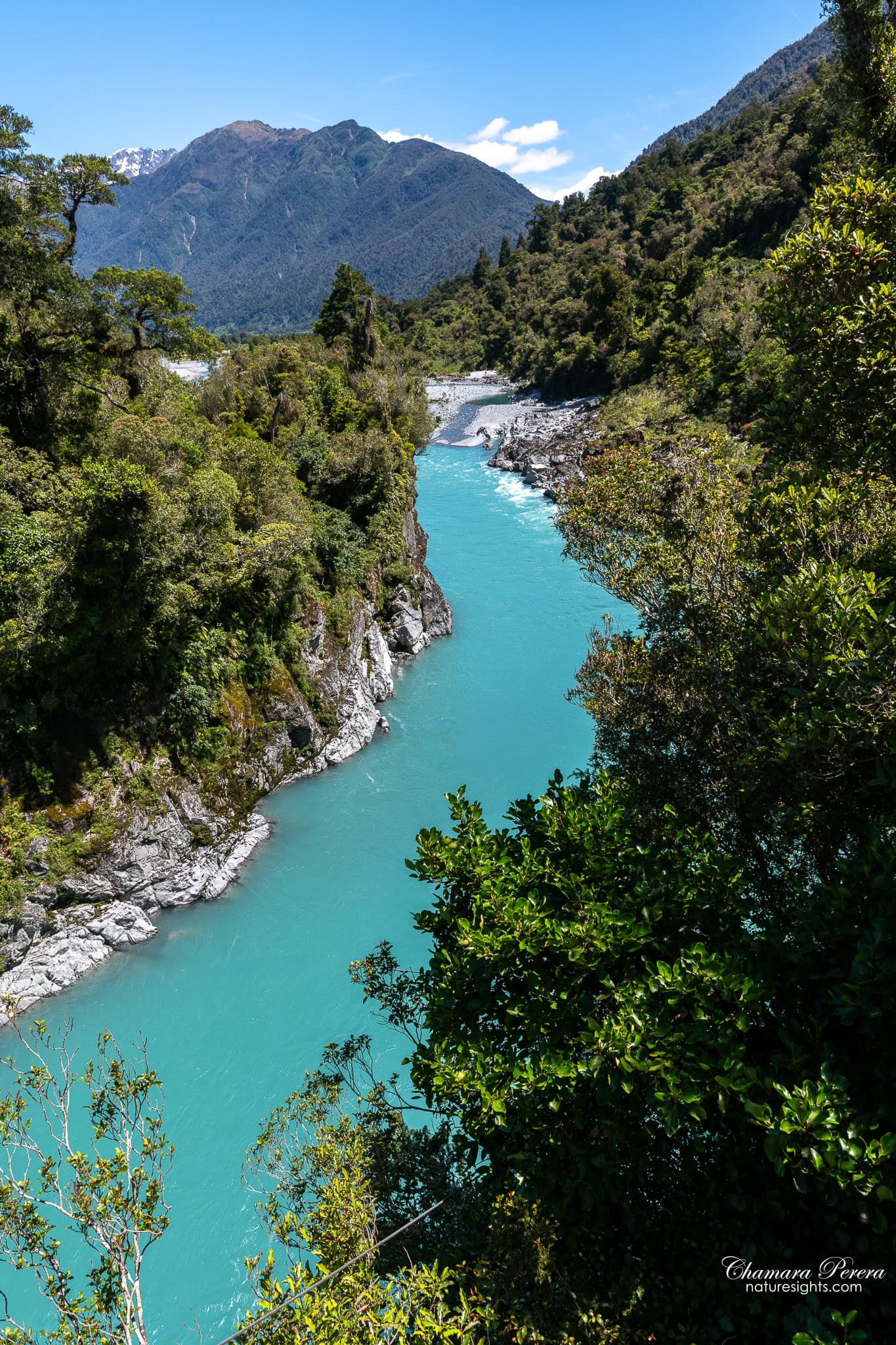
I’d seen enough photos of Hokitika Gorge online to know the water was going to be turquoise. What I hadn’t accounted for was how intense that colour is in person. I pulled up at the car park on a clear summer morning, walked five minutes down the track, and stopped at the first view of the river. The colour doesn’t look real. It looks like someone turned a saturation slider up too far.
The gorge is 33 kilometres from Hokitika township on the West Coast of New Zealand’s South Island, carved by the Hokitika River as it pours out of the Southern Alps. The water runs through glaciated mountain terrain before it reaches you here, picking up glacial rock flour along the way – fine particles of ground stone held in suspension that scatter blue light and block the rest. Knowing the science doesn’t change what you see when you get there.
What Is Hokitika Gorge?
The Hokitika River drains the central Southern Alps, running roughly 50 kilometres from the mountains to the Tasman Sea at Hokitika. The gorge section is where the river cuts through a narrow band of schist rock just before the hill country flattens out toward the coast. The walls rise 15 to 20 metres above the river in the tightest sections.
DOC manages the Hokitika Gorge Scenic Reserve. Entry is free. There’s a car park, a short formed track to the gorge viewpoints, and a suspension bridge over the river: no café, no entry gates, no guided tour infrastructure. You walk in, see the gorge, walk out.
The reserve is small by New Zealand standards. This is a short visit, not an all-day excursion. But I’ve been to a lot of natural sights in New Zealand and very few of them hit you this fast.
The Hokitika Gorge Walk
The main track runs about 1.2 kilometres from the car park to the suspension bridge. The track follows the river inland from the car park, with the first views of the water coming through the trees within a few minutes of starting. There’s a flat boulder field section where you walk along the river bank. This is the best spot for photographs at water level and worth slowing down rather than rushing straight to the bridge.

From the car park to the swing bridge takes around 15 minutes at a normal pace. The full out-and-back takes 30 to 45 minutes, though I stayed well past that. There’s also a short loop option back to the car park from the bridge if you don’t want to retrace the same path.
The track is accessible for most fitness levels. There are no significant climbs and the ground is reasonably even. The tree roots need attention in wet conditions.
The Suspension Bridge
The suspension bridge draws the most visitors in the reserve. It’s a wooden-planked swing bridge crossing the river at a narrow point in the gorge, with around 10 metres between the planks and the water.
From the bridge you look directly downstream into the gorge as it curves away through native bush. The rock walls are pale grey schist. The water is vivid turquoise. The Southern Alps sit behind. On clear days you can see snow on the peaks upriver.
The bridge moves when people walk across it. Fine for most visitors. If suspension bridges make you uncomfortable, the boulder field section earlier on the track gives equally good views at ground level – arguably better for photography.

Why Is the Water So Blue?
The turquoise comes from glacial rock flour carried in the Hokitika River. When glaciers grind against rock in the Southern Alps, they produce extremely fine particles – silts finer than anything deposited by a normal river. These particles stay suspended in the water column rather than settling to the bottom. They scatter blue and green wavelengths of light while absorbing the longer ones. That’s the colour.
It varies with conditions. After heavy rain the river muddies and the turquoise disappears completely. On a clear sunny day with stable flow, it’s at its most concentrated. I visited in summer after several days of fine weather and the colour was as strong as any photograph I’d seen of the place.
Photography Tips
Morning before 10am is the right time. The gorge runs roughly east-west and morning sun enters from the east, lighting the water and rock faces directly. By mid-morning the light is overhead and the turquoise washes out against a bright sky. The drive from Hokitika takes 35 minutes, so leaving at 7am puts you there in the good window.
Don’t go straight to the bridge. The flat boulder field halfway along the track gives you low-angle river access – pale greywacke boulders in the foreground, gorge walls behind. This is a more grounded composition than the elevated bridge view and the spot I kept coming back to.
The bridge puts you above the river looking straight down the gorge axis, rock walls framing both sides. A polarising filter cuts the surface glare off the water and deepens the colour noticeably. Shoot toward the light in the morning, facing upriver, and the turquoise saturates. Shoot downstream and the gorge walls and native bush recede into shadow.
The mountains only appear behind the gorge if you’re shooting upriver with a clear sky. Worth spending time at both ends of the bridge.
I shot with a 24-70mm and found the 35 to 50mm range most useful from the bridge. The boulder section works wider, around 24mm. A polarising filter matters here more than almost anywhere else I’ve shot in New Zealand.


How to Get to Hokitika Gorge
The gorge is 33 kilometres from Hokitika township. The route heads inland along Stafford Road and Kokatahi-Kaniere Road, passing through the farming community of Kokatahi. The first 25 kilometres are sealed. The final section is gravel – well-maintained when I was there, but worth checking conditions in wet weather. A standard 2WD car is fine.
- From Hokitika: 33km, around 35 to 40 minutes
- From Greymouth: 75km, around 1 hour 15 minutes (south to Hokitika, then inland)
- From Franz Josef: 165km, around 2 hours via State Highway 6 north
There’s no public transport. You need your own vehicle.
The gorge sits well inland from the West Coast highway, so it’s a dedicated detour rather than a roadside stop. Factor the return drive into your day – it’s an hour and a bit of driving round trip from Hokitika, more from Greymouth.
I visited after coming off the TranzAlpine train from Christchurch and picking up a hire car in Greymouth. We’d already been up to Punakaiki and the Pancake Rocks before heading south, and the gorge was the next detour inland before continuing down toward Franz Josef.

Best Time to Visit Hokitika Gorge
Any time the river is running clear. That’s the main variable, not the season.
The West Coast averages around 2800mm of rain per year in Hokitika. After sustained rain, the river runs grey-brown and the turquoise is gone. This can happen in January as easily as July. If you drive out after a storm, you may find nothing remarkable.
I went in summer and had a clear, sunny day. The colour was exactly what I’d hoped for. The car park was filling by 10am. Go early.
Go in the morning. The gorge gets busier through the day, particularly on settled summer days when people drive out from Hokitika after a slow breakfast. Check the weather before going. If it’s rained heavily in the previous 48 hours, the river may still be discoloured.
Where to Stay Near Hokitika
Hokitika township is the nearest town – 33 kilometres from the gorge, 35 to 40 minutes. There are motels, holiday parks, B&Bs and self-contained cottages. It’s a small town but accommodation isn’t hard to find outside peak summer.
Greymouth, 40 kilometres north on State Highway 6, is larger with more options. If you’re based there and heading south, the gorge makes a natural first stop before continuing down the coast.
I stayed at the Fitzherbert Court Motel in Hokitika the night before visiting and left early in the morning. It’s well placed in town – easy to get out quickly without navigating through anything on the way.
Practical Tips
- Entry is free. No fees for the car park or the track.
- There are toilets at the car park. No facilities at the gorge itself.
- The car park holds around 20 vehicles. On busy summer days it fills – arrive early.
- The last section of road is gravel. Standard 2WD is fine in dry conditions; check after heavy rain.
- Sandflies are present near the river and in sheltered vegetation. Bring DEET repellent – this is the West Coast.
- The track is not technically demanding but has tree roots and some uneven ground. Thongs are not ideal.
- Children need supervision near the river bank. The water is cold, the gorge current is fast, and the depth drops quickly from the boulders.
- Budget at least 45 minutes. An hour is more realistic if you’re taking photographs.
- The bridge has a weight limit – signs are posted at each end.
- Rain doesn’t ruin the walk, but it affects the water colour. A cloudy day with no recent rain is fine. A day after heavy rain is not.


FAQs
How Long Does It Take to Do the Hokitika Gorge Walk?
Car park to the suspension bridge and back is 30 to 45 minutes if you keep moving. I stopped at the boulder section, spent time on the bridge, came back to the boulders. Plan an hour minimum.
Why Is the Water So Blue at Hokitika Gorge?
Glacial rock flour. When glaciers grind against rock in the Southern Alps, they produce extremely fine particles that stay suspended in the water rather than sinking. Those particles scatter blue and green light. On a clear sunny day with stable river levels the colour is as intense as any photo you’ve seen. After heavy rain it goes grey-brown and the whole point disappears.
Do You Pay to Visit Hokitika Gorge?
No. DOC manages the reserve. Entry and parking are free.
Is Hokitika Gorge Worth Visiting?
Yes, if the river is running clear. That’s the only real condition. The turquoise is genuine – as striking in person as it looks online. But drive out after heavy West Coast rain and you’ll find a grey-brown river and not much else. Check the weather before making the 33-kilometre trip inland. A clear day is one of the better half-day stops on the West Coast.
Can You Swim at Hokitika Gorge?
I wouldn’t. The water is snowmelt cold, the current through the gorge is stronger than it looks, and the depth drops fast off the boulder banks. DOC doesn’t explicitly prohibit it. The conditions just aren’t safe.
The turquoise is real. The photos aren’t edited. I stood on the suspension bridge for longer than made sense, watching the colour shift slightly as cloud moved across the sun. The Southern Alps were out behind the gorge.
The drive back to Hokitika takes 35 minutes through farmland and hill country. It goes faster on the way out.
Explore more of New Zealand on NatureSights.
